Kanima kills the auto mechanic
Holding Out for a Hero ▸ Stiles Stilinski (2)Kanima kills the auto mechanic during an attack at the Mechanics garage, a turning point that transforms the creature from a frightening rumor into a demonstrably lethal force. The scene is defined by three linked values: the mechanic’s immediate survival, Carson Bradley and Stiles Stilinski’s freedom to intervene, and the investigators’ ability to understand what they have witnessed. All three collapse almost at once. A clawed, scaly hand reaches down toward the worker, a tail cuts across the back of his neck, and he falls before help can reach him. The attack leaves Carson and Stiles trapped between paralysis, machinery, and an enemy whose identity remains only partly recognizable.## Causes and Background The garage murder occurs within a widening pattern of violence in Beacon Hills. The creature’s appearance is not an isolated monster encounter but part of a series of killings that also includes a murdered couple and later attacks associated with Lydia Martin’s hospital disappearance. When Carson and Allison Argent later discover clear ooze dripping from a window sill at the school, Carson recognizes it as the same substance seen at the auto shop. That recurrence turns the garage from a self-contained crime scene into one location in a chain of encounters, with the transparent residue functioning as a physical signature of the Kanima’s presence.
The scene also gains investigative weight through the discovery that the mechanic shared a defining connection with the other victims. Sheriff Stilinski’s evidence review establishes that the mechanic and the murdered couple had something in common, invoking the recurring investigative principle that one incident is isolated, two incidents suggest coincidence, and three incidents form a pattern. The crime therefore supplies both a victim and a category: the mechanic is not merely killed by an unknown creature, but becomes part of a deliberately organized series whose logic the characters must uncover.
What Happens at the Mechanics Garage
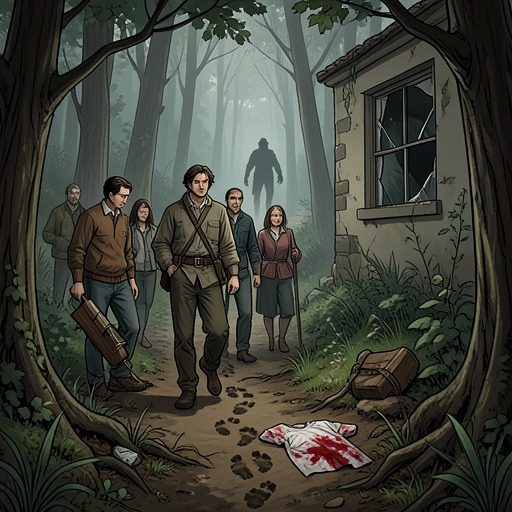
Carson and Stiles enter the building and pause when they hear the faint sound of a shower running, but the garage’s apparent ordinary activity gives way to immediate danger. Stiles warns Carson not to touch the door. His arm is vibrating, and under Carson’s hand he begins to go limp, showing that the attack has already affected his body before the creature fully reveals itself. Looking through the window, Carson sees the worker outside and then the Kanima’s clawed, scaly hand reaching down toward him.
The Kanima kills the mechanic with a swift movement of its tail. The tail appears to slice the back of the worker’s neck, followed by the thud of his body striking the ground. Carson calls out, and the creature turns its yellow eyes toward her. Its appearance is monstrous, but its gaze is also disturbingly familiar to Carson; she recognizes something in the way it looks at her without being able to identify what that familiarity means. The creature answers her with a shrieking hiss, preserving the scene’s central uncertainty even as its capacity for violence becomes undeniable.
The attack then spreads from the mechanic to the witnesses. Stiles tumbles to the floor, apparently paralyzed and barely able to move, reaching for his phone and rasping out the emergency number. Carson understands the gesture, enters the number for the police, and hears the call begin to connect. At the same moment, a loud mechanical noise reveals that the lift is moving downward while the repair worker remains beneath it. Clear goo glints on the door handle, suggesting that the same substance may have caused Stiles’s paralysis and making the door itself dangerous to touch.
Carson is forced into an impossible choice. The worker is about to be crushed, but opening the door may expose both witnesses to the Kanima, and contact with the residue may leave Carson unable to act. The lift comes within centimeters of the mechanic. Stiles’s Jeep covers him, but the protection is insufficient; Carson closes her eyes, hears a crunch, and understands that the rescue has failed. By the time the emergency operator asks what is happening, it is already too late.
Immediate Aftermath
Rain is pouring down when Carson Bradley, Stiles Stilinski, and Sheriff Stilinski sit on the tailgate of the ambulance in the small parking lot. Ambulance and police lights flash around them, while Scott McCall’s bicycle stands alone in the corner. Stiles has finally regained feeling in his body, but recovery does not undo what they have witnessed: the mechanic is dead, the creature has escaped their control, and the witnesses must reduce a violent supernatural encounter to a story that authorities might accept. Stiles repeatedly claims that they walked in and saw the Jeep on top of the mechanic, while Carson silently agrees. The account is technically connected to the scene, but it conceals the Kanima, the paralysis, and the creature’s role in the killing.
Sheriff Stilinski questions his son further and clearly does not believe the simplified explanation. Carson, however, is unable to concentrate on the ordinary questions because the garage has altered the scale of the danger around them. Werewolves had already made Beacon Hills unsafe; the attack introduces a different kind of threat, one that kills through speed, venom, and concealment. The mechanic’s death also leaves Carson with the immediate moral burden of having been close enough to see the danger but unable to prevent it. The scene therefore ends not with resolution, but with survivor shock, an improvised cover story, and Carson’s growing conviction that the creature’s gaze was familiar.
Evidence and Pattern Recognition
The auto-shop murder becomes more legible only after the characters begin comparing crime scenes rather than treating each death as an isolated horror. Hospital surveillance footage is later reviewed in an attempt to identify Matt Daehler in connection with Jessica’s murder. The search is difficult because the hospital was crowded after a six-car pileup, and the available footage contains hundreds of people in wheelchairs and on gurneys. This visual abundance contrasts with the missing explanation at the garage: cameras may preserve movement, but they do not automatically reveal motive or supernatural identity.
The investigation then turns to physical records. Sheriff Stilinski’s files contain shoeprints alongside tire tracks at the trailer park, and the comparison is expected to place Matt at three murder scenes: the trailer, the hospital, and the rave. A credit-card receipt signed by Matt at the garage when the mechanic was killed extends the connection to a fourth location. The mechanic’s death thus becomes part of the accumulating case against Matt, not because the scene itself initially identifies him, but because ordinary evidence gradually links him to the Kanima’s wider pattern of violence.
The pattern is strengthened by the shared connection among the mechanic and the murdered couple. The discovery transforms the investigation from a search for a random predator into an inquiry into selection and punishment. Later, the statement that the killers are killing murderers reframes the victims within a revenge logic: the murders are presented as acts of judgment rather than indiscriminate attacks. Yet the garage scene complicates that claim. Whatever the victims may have in common, the mechanic’s death is still carried out through a monstrous body and leaves Carson and Stiles exposed to paralysis, machinery, and fatal force.
Recurrence and Retrospective Meaning
The clear ooze at the Mechanics garage does not remain a single unexplained detail. During a later school confrontation, Carson and Allison Argent see the same substance dripping from an open window sill. Carson immediately recognizes the resemblance to the residue at the auto shop and warns Stiles that the creature is present. That recurrence gives the earlier scene a material continuity: the goo is not merely part of the garage’s atmosphere, but a trace that allows the characters to track the Kanima across locations.
The Kanima’s connection to hospital violence also gains force through Lydia Martin’s disappearance. When Carson and the others enter Lydia’s hospital room after hearing a shower running, they find the shower still on and the curtain partly open, but Lydia is gone. There are no connecting rooms beyond the bathroom and her hospital room, and no sign explains how she vanished. The disappearance does not prove that the Kanima killed the mechanic, but it places the garage murder within the same atmosphere of impossible movement, hidden access, and bodily vulnerability. The creature’s attacks repeatedly turn familiar places—an auto shop, a hospital, and a school—into spaces where people can disappear or die before help arrives.
Trauma and Narrative Significance
The murder continues to shape Carson after the immediate crisis. The following morning is described as slightly better only because she wakes without crying and her eyes are less sore than the previous night. In her room, Stiles lies pressed against her with his arms around her and their hands entwined, offering physical reassurance after the violence they have survived together. The quiet intimacy does not erase the garage; it shows how recovery depends on proximity, touch, and the restoration of bodily safety after the Kanima has made touch itself dangerous.
Carson later sits outside the guidance office, picking at the string on the bottom of Stiles’s plaid shirt while waiting for an impromptu meeting arranged by Ms. Morrell. The school considers the meeting necessary because Carson was held hostage, and Sheriff Stilinski has explained that Matt took him out after Carson went down at the police station. Carson and Stiles blacked out for at least half an hour, and a paramedic checked Carson for a concussion; she had a mild one but did not require an overnight hospital stay. The account shows that the auto-shop attack is one part of a continuing sequence of exposure, paralysis, abduction, and memory gaps rather than an isolated fright.
As an action, the mechanic’s killing fuses horror with investigation. Its most visible fact is the worker’s death, but its deeper consequence is the creation of a chain: the Kanima leaves a recognizable residue, the victims share a connection, physical records draw Matt toward multiple scenes, and survivors carry the violence into later investigations and attempts at recovery. The attack’s decisive reversal is the collapse of the expectation that witnesses can simply call for help. By the time the phone connects, the machinery has already completed what the creature began, leaving Carson and Stiles alive to interpret a crime they could neither stop nor truthfully explain.